Our office is on Bhagwati Bahal, a short walk from Thamel Marg. Every season we watch the same scene where travellers go from shop to shop with a few quotes in their hands. The brochures of almost all trekking companies look alike,the route is the same and everyone claims to be the best Everest Base Camp trekking company in Nepal.
When you are at Gorak Shep, 5,164 m, each breath holds about half the oxygen it does at sea level. Your head hurts, you slept badly, and you have to decide: go on, rest, or turn back. The brochure cannot help you at that moment but the person standing next to you can.
That is the real difference between companies. They all walk the same trail, from Lukla to Namche to Dingboche to Everest Base Camp. What changes is who makes the safety calls, how much spare time is built into your plan, and what is written on paper.
So here are nine simple checks that you need to consider while choosing every company on your list, including us. Each check tells you what good looks like and why it matters.
We also show how Higher Limits Trek and Expedition answers each one. By the end, you will know how to choose the best company for the Everest Base Camp trek without guessing.
Same Route, Different Trek: What an Everest Base Camp Trekking Company Really Changes
Every operator follows the same classic line: Lukla, Phakding, Namche Bazaar, Tengboche, Dingboche, Lobuche and Gorak Shep.
Then comes Everest Base Camp at 5,364 m, and the early-morning climb to Kala Patthar at 5,545 m. You can see our version day by day in the 16-day Everest Base Camp Trek.
So you cannot judge the best company for the Everest Base Camp trek by its route.
Judge it on three things:
Who is allowed to stop your climb?
How much slack is in the schedule?
How honest is the paperwork?
The nine checks below answer all three:
Legal registration
Local operator or overseas agent
A schedule that respects altitude
Guide licence and authority
Safety systems and evacuation
How porters and guides are treated
What the quote includes
Reviews you can trust
The plan for weather, flights and health
1. Is the Company Legally Registered? Check It in Five Minutes
The best company for the Everest Base Camp trek starts with paperwork anyone can check. A real Everest Base Camp trekking company in Nepal has a company registration, a tourism trekking-agency licence and a tax registration.
Membership of the Trekking Agencies’ Association of Nepal (TAAN) and a listing with the Nepal Tourism Board (NTB) add proof of standing. They are not the licence itself, but they help.
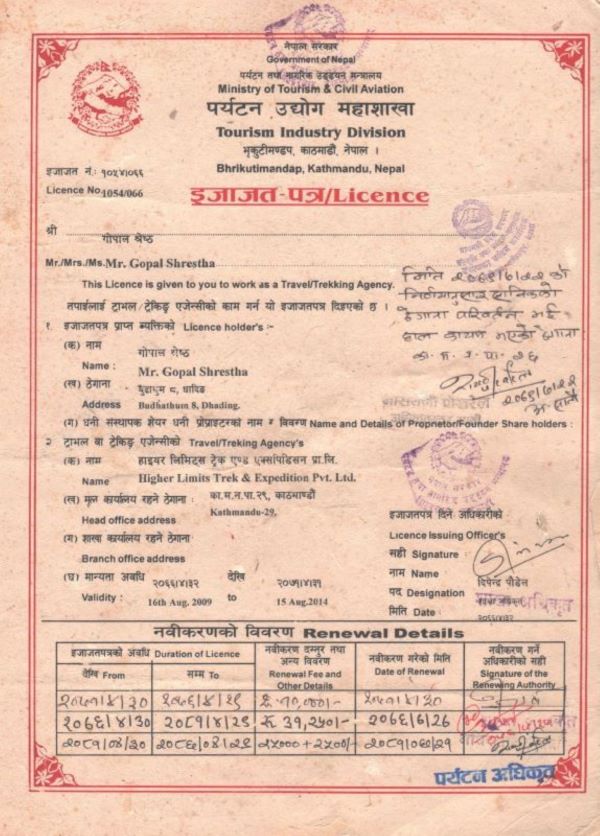
Trekking Agency License from Department of Tourism
Try this quick test:
Ask for the registration number and the tourism licence number.
Look up the company name in the TAAN member directory and the NTB listing.
Call the office on video, or walk in if you are already in Kathmandu.
Ask for a copy of your guide’s licence.
Be careful with sellers who only exist on Instagram, and with shops whose receipts carry no company name. If something goes wrong on the trail, you want a registered business you can reach.
You can look us up yourself. Higher Limits Trek & Expedition Pvt. Ltd. is listed in the TAAN member directory under Reg. No. 64902/066/067, with our address at Bhagwati Bahal, Thamel Marg.
Our License No. is 1054/066, and we are also affiliated with NTB, the Nepal Mountaineering Association (NMA) and KEEP. All documents are on our Legal Documents page, and you can read more about us.
2. Local Operator or Overseas Agent: Who Really Runs Your Trek?
Many bookings travel down a chain. An overseas seller takes your booking, a Nepali operator runs the trek, and a guide meets you at the airport. Each link adds a fee and a delay. When your Lukla flight changes at 5 a.m., a message passed through three desks is the last thing you want.
To be fair, overseas agents have real strengths. You may get familiar payment methods and consumer protection in your own country. A local operator offers something different: a direct line to the person who hires and briefs your guide.
Here is a simple test. Ask for a name and a mobile number in Kathmandu that you can call early in the morning. Then ask, who is the operator of record? That means the company that actually runs the trek on the ground.
Higher Limits is locally owned, and our own Gopal Shrestha leads it. You can message him on WhatsApp at +977 9851163811. Every booking also comes with a personal trip planner in Nepal, so you always know who to ask. Whichever Everest Base Camp trek operator you pick, ask for this kind of direct access.
3. Does the Schedule Protect You From Altitude? Count the Rest Days
Altitude is the main risk on the EBC trek, and the schedule is your first protection. A common guideline says that above3,000 m you should gain only about 500 m of sleeping height each night, and rest every three to four days. A good Everest Base Camp trek itinerary follows that pattern.
Here is how our 16-day trek looks night by night:
Night
Sleeping altitude
Change from previous night
Phakding (Day 3)
2,610 m
−250 m from Lukla
Namche Bazaar (Day 4)
3,440 m
+830 m
Namche rest day (Day 5)
3,440 m
0
Tengboche (Day 6)
3,860 m
+420 m
Dingboche (Day 7)
4,410 m
+550 m
Dingboche rest day (Day 8)
4,410 m
0
Lobuche (Day 9)
4,940 m
+530 m
Gorak Shep (Day 10)
5,164 m
+224 m
Let us be honest about this table. Three jumps (+830, +550 and +530 m) are above the rule of thumb. What matters is that each one sits right next to a rest day at Namche or Dingboche. That is the pattern to look for in any Everest Base Camp trek itinerary.
Our rest days are not lazy days. On Day 5 you walk up to the Everest View Hotel at 3,880 m. On Day 8 you hike toward Nagarjuna Hill at about 5,050 m and then come back down to sleep. Trekkers call this “climb high, sleep low”, and it is how the best company for the Everest Base Camp trek builds adjustment into the plan.
Be careful with 10 to 12 day schedules and with packages that fly you back by helicopter. They squeeze this process.
4. Who Is Guiding You, and Can They Turn You Around?
Your guide is the most important safety feature of the EBC trek. Ask for the guide’s name, government licence, first-aid training and number of Base Camp trips. A good Everest Base Camp trekking company will answer without delay.
Then ask the question that matters most. Can the guide stop your climb without calling the office first? A guide who is paid only when the trek is finished may feel pushed to keep going. A guide who is free to say “we rest here” or “we go down” is worth more than any itinerary detail.
Also ask how many trekkers one guide looks after, and when an assistant guide joins a bigger group. Real answers sound specific. Vague answers sound like a sales script.
At Higher Limits, every guide holds a government licence, and the licences are displayed in our Thamel office. Our guides are trained in first aid, eco-trekking, altitude sickness and rescue procedures.
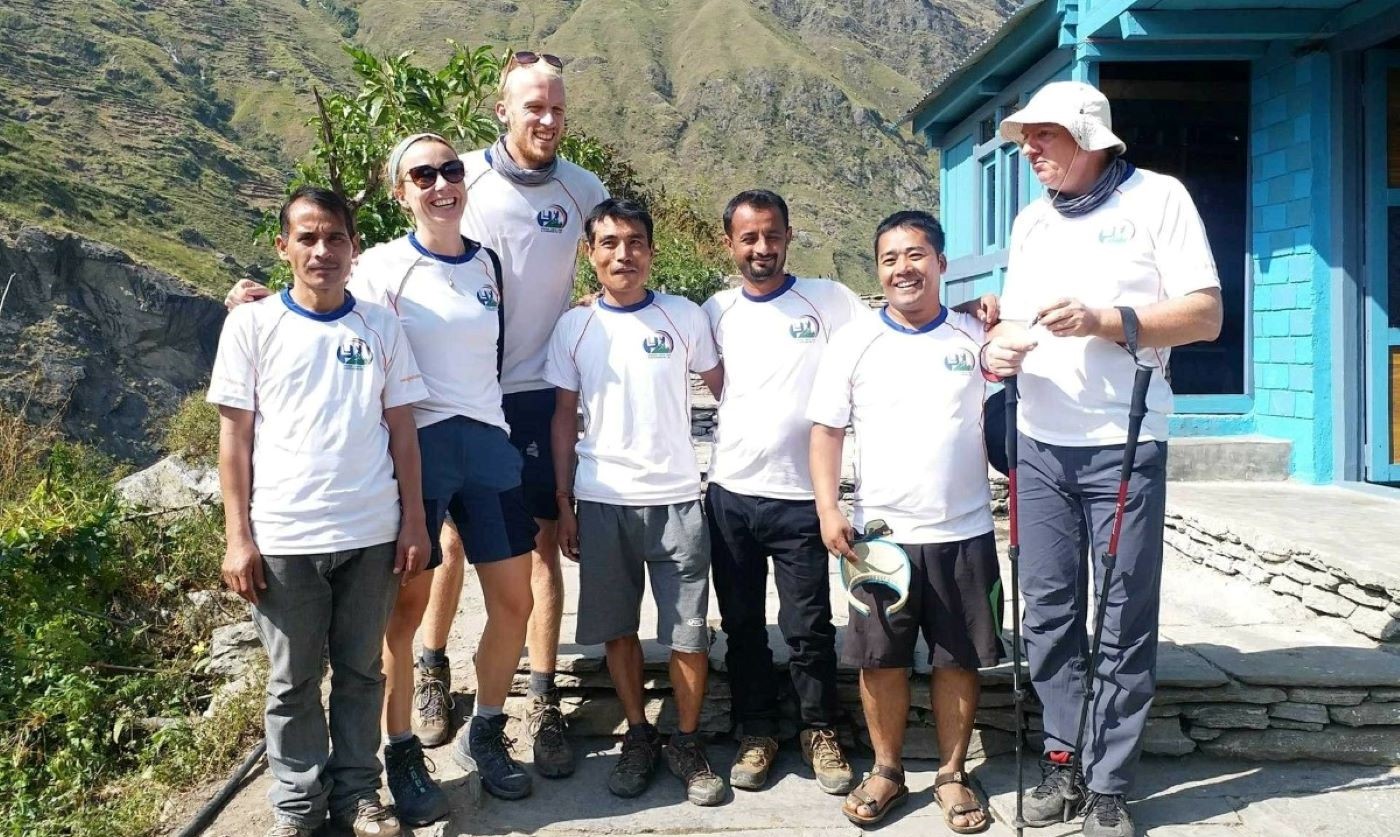
Team of Higher Limits Trek with our valued clients
Each evening your guide explains the next day’s distance, terrain and sights, and that is the best time to ask your own questions. You can meet the people behind our trips on the Meet Our Team page, and read more about our trekking guides and porters.
5. What Safety Systems Exist Beyond the Guide?
A good guide still needs tools and a clear system.
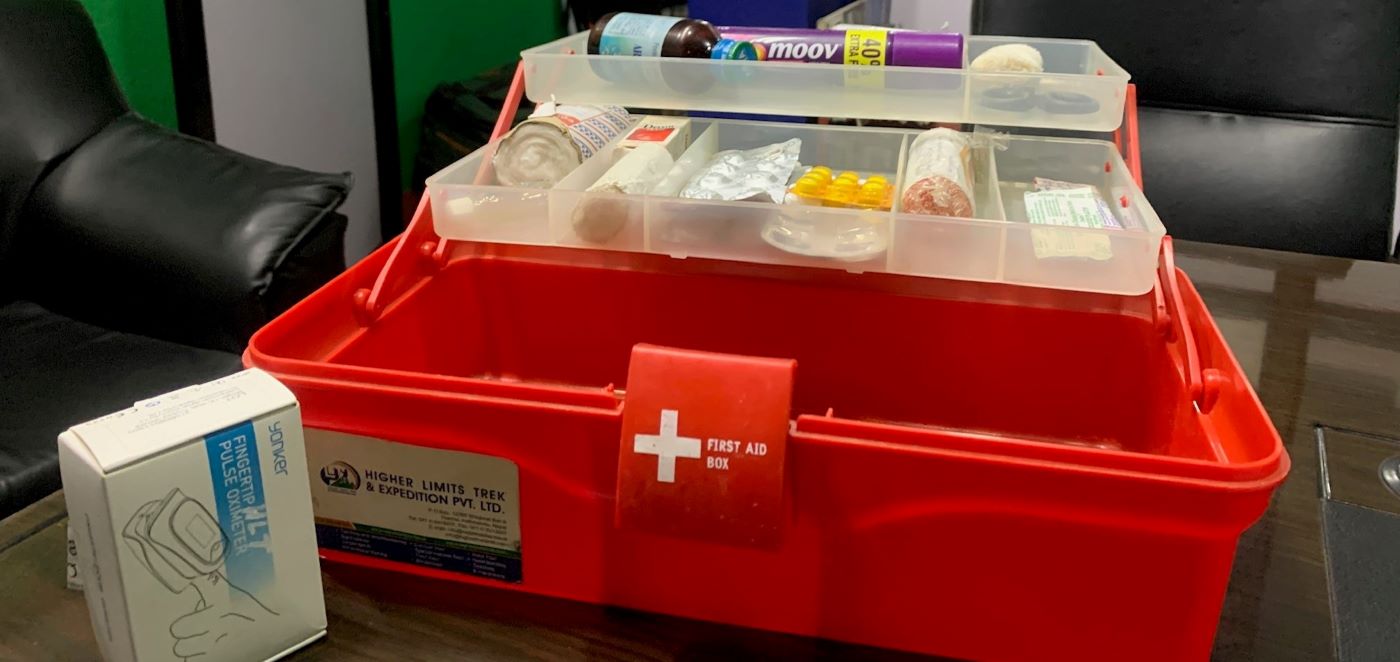
First Aid Kits Box
When you compare any Everest Base Camp trekking company, check four things:
Monitoring: Oximeter and pulse checks every evening, ideally written down. A falling trend matters more than one single reading.
Kit: Ask what is in the medical kit, and whether guides carry extra oxygen or a portable altitude bag during the high mountain expedition. Get the answer in writing.
Evacuation: Ask who decides on a helicopter, who chooses the rescue company, and who pays. Your travel insurance pays for the evacuation, not the trekking company. Nepal has looked into inflated rescue claims in the past, so the decision process is a fair thing to ask about.
Insurance: Your policy should cover trekking up to 6,000 m, helicopter evacuation, medical bills and travel home. Read the altitude clause before you buy.
Here is the hard truth: going down is the only real treatment for altitude sickness as no tablet and no kit replaces it.
Our guides carry a medical kit and an oximeter. Every evening they check your oxygen level and pulse, so small problems are caught early. We arrange emergency helicopter rescue if it is needed, paid by your travel insurance.
On Day 11 the trail passes the Himalayan Rescue Association post at Pheriche, and it is worth stopping there for the talk on altitude. This is the standard to expect from the best company for the Everest Base Camp trek.
6. How Does the Company Treat Its Porters and Guides?
Ask four simple things: how much one porter may carry, whether the crew is insured, what clothing and sleeping gear they get, and how they are paid.
This is not only about being kind. A cold, underpaid, poorly equipped crew makes weak decisions at 5 a.m. on a frozen trail, and you are walking with them.
Higher Limits follows the rules of the International Porter Protection Group (IPPG). Our guides and porters are insured. We suggest one porter for every two trekkers, with each trekker adding about 10 to 12 kg, so no porter carries too much. Porters are an optional add-on, and many people enjoy the walk more with only a light daypack.
If an Everest Base Camp trekking company cannot explain its porter policy in a few clear sentences, move on and choose the next one.
7. What Should an Everest Base Camp Trek Quote Include?
The best company for the Everest Base Camp trek gives you a quote you can read line by line. Lukla flights and park permits are basic costs for every operator, and they come before a single night of lodging, a meal or a guide’s wages.
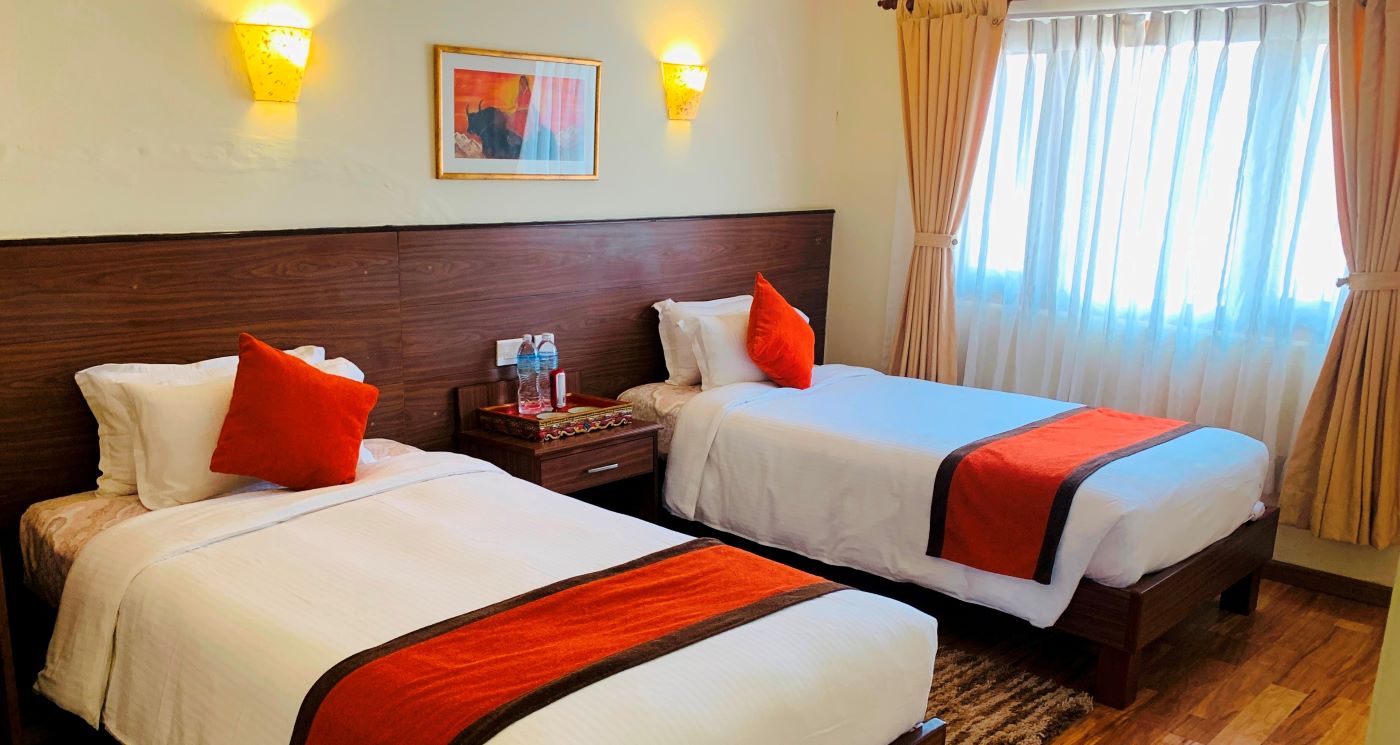
The Accommodation we offer
So when one quote looks very different from the others, do not just ask why it is higher or lower. Ask which lines are missing.
Put two quotes side by side and compare these eight lines:
Line
What to confirm
Our 16-day trek
Kathmandu stay
Nights, hotel class and sightseeing
Four nights in a 2 to 3 star hotel with breakfast, plus a guided tour of four UNESCO sites (entrance fees extra)
Lukla flights
Route, airport tax and delays
Return flight from Kathmandu or Manthali, domestic airport tax included
Permits
Which ones, and who buys them
Sagarmatha National Park permit and the Khumbu Pasang Lhamu fee, arranged by us
Food and beds
Is it full board?
Breakfast, lunch and dinner with tea or coffee, twin-share tea houses and seasonal fruits while on the trek
Porter
Included or optional?
Optional add-on
Gear loan
Sleeping bag, jacket, duffel
Sleeping bag, down jacket and duffel bag on loan if needed
Insurance
Yours and the crew’s
Yours is compulsory; the guide’s insurance is included
Left out
Visa, some meals, extras
Visa, Kathmandu lunch and dinner, bottled water, hot showers, charging, tips and helicopter evacuation
The Kathmandu day covers the same ground as our Kathmandu day tour. You also get a trekking map, a branded T-shirt, a medical kit with an oximeter, and a trip completion certificate.
The full list of inclusions is on the Everest Base Camp Trek page. Whoever you compare us with, ask for the same eight lines.
8. Do the Reviews Hold Up? How to Read TripAdvisor and Google
The best company for the Everest Base Camp trek shows you its problems as well as its praise.
Read reviews like a detective:
Start with the 3 and 4 star reviews. They talk about how the trip was run, not just the views.
Look for guide names, travel dates and real events: a flight delay, a case of altitude sickness, a change of lodge.
Notice how the company replied to complaints.
Check that the reviews are recent, mention the same itinerary, and appear on more than one website.
Ask the company for contact details of two past clients who travelled in your month.
As of November 2026, Higher Limits has 76 reviews on TripAdvisor and 21 on Google. That is fewer than the biggest agencies, so please read them instead of just counting stars. You can find more on our client reviews page.
9. What Is the Plan if Weather, Flights or Health Change the Schedule?
The best company for the Everest Base Camp trek plans for things going wrong, because on this trail something nearly always shifts.
Lukla’s short, sloping runway depends on the weather. In busy months some flights leave from Manthali (Ramechhap), after a long drive from Kathmandu that starts before sunrise.
Ask three questions:
What is covered if flights are delayed?
Who pays for extra hotel nights?
What are the cancellation and refund terms, in writing?
Also keep one difference clear. A medical evacuation is an insured emergency. A charter flight that only saves your schedule is usually your own expenses.
Our itinerary keeps a spare day in Kathmandu (Day 15) as a safety net, and our team will rebook and look after you if your flight is delayed. If you do not want the long walk down, a helicopter return from Everest Base Camp is available as an optional add-on.
The checks above cover the substance: licences, rest days and clear quotes.
When you choose the best company for the Everest Base Camp trek, also watch how an operator behaves while selling to you:
Deadline pressure, such as “this offer ends tonight”
Promises of clear weather or a guaranteed view
Refusing to put sleeping altitudes in writing
Asking you to pay into a personal account that does not match the licensed company name
Not wanting to do a video call
Any one of these is a good reason to pause.
Copy and Send This Email to Every Company on Your Shortlist
Want to compare any Everest Base Camp trekking company fairly? Send the same nine questions to each one, and judge the written answers.
Please send your registration and tourism licence numbers.
Who runs this trek in Nepal, and whom can I call there?
List each night’s sleeping altitude and every rest day.
Who is my guide, what licence and first-aid training do they hold, and can they stop my climb?
What do your guides carry for altitude emergencies, and who decides on evacuation?
What are your porter load limits, insurance and pay policies?
Send a line-by-line quote with every exclusion.
Which past clients can I contact?
What is covered if flights are delayed, and what are the cancellation terms?
Send the same nine questions to us through our contact page. We will answer them in writing.
Is Higher Limits the Best Company for the Everest Base Camp Trek for You?
Higher Limits Trek & Expedition has worked from Thamel since 2009. We focus on small-group and private trips, we shape itineraries around your time and needs, and we support a non-government organisation that brings health and education facilities to remote parts of Nepal.
At the end of your trek you get a farewell dinner with a cultural program, a completion certificate, a T-shirt, a cap and a trekking map.
Our trek suits you if you are a first-timer or experienced trekker who wants a guided 16-day trek with two acclimatization days and a spare day, and you like having direct access to the people running it.
Look elsewhere if the lowest quote is your only filter, because we are not the cheapest and porters are optional. If you want a faster schedule with more comfort, see our Everest Base Camp Luxury Trek.
The path to Everest Base Camp is the same for everyone. The trek you actually have depends on the company you choose. Before you pay a deposit, make sure you can see the licence, meet the guide, read the sleeping altitudes, understand every line of the quote, and reach a real person in Kathmandu.
No company can control the weather or make 5,364 m easy. What the best company for the Everest Base Camp trek can do is make the decisions around the mountain clear, calm and safe. Use the nine checks, send the email, and trust the company that answers every question in writing.
If you would like to start with us, check dates and book the Everest Base Camp Trek, or message on WhatsApp at +977 9851163811. We would be glad to walk through your first few questions with you.
Frequently Asked Questions
Can you trek to Everest Base Camp in 2026 without a guide or trekking company?
The rules are changing. National rules since 2023 point to a licensed guide booked through a registered agency, but the Khumbu Pasang Lhamu Rural Municipality has said it will not enforce that on its own trail. Always confirm the current position with a registered operator before you travel. Even where it is allowed, nobody else will check your oxygen levels or call a rescue for you. More answers are in our general FAQs.
Is booking online safer or riskier than booking in Kathmandu after you land?
Walk-in deals rarely save much. In busy months Lukla seats and hotels sell out, and it is hard to find the best company for the Everest Base Camp trek while you are tired from a long flight. Book once your dates are fixed. Our guaranteed departures are listed on the package page, and you can also look at last-minute departures.
How do I pay a deposit safely?
Pay only to the company name that appears on the licence. Ask for written confirmation that shows the itinerary, the inclusions and the refund terms, and avoid personal accounts. You can pay through our payment page.
Will I trek alone, in a private group or with strangers?
Our Everest Base Camp trek runs for groups of 1 to 12, and every departure is guaranteed once it is booked. Private and small-group trips are our focus. Tell us your dates and we will explain how your trek would be set up.
Can I add Kathmandu, Pokhara or Chitwan to the trek?
Yes. Use the spare day for a guided visit to Patan or Bhaktapur, then add a Pokhara valley tour or a Chitwan jungle safari after the trek. Avoid booking your flight home on Day 16 without a buffer.
What happens between booking and Day 1?
We ask for your passport details so we can arrange the permits. You send us a copy of your travel insurance and arrange your Nepal visa, which is not included. Your passport must be valid for at least six months and have a blank page. On Day 2 your guide meets you at our Thamel office or your hotel to explain the route, safety, weather and packing.
How should I tip, and how is it handled?
Tips for guides and porters are not part of the trek. We explain how it works at your briefing, and the farewell evening in Lukla on Day 13 is the usual time to say thank you.
When is the best time to book the Everest Base Camp trek?
Most trekkers choose spring (March to May) or autumn (September to November), when skies are usually clearer and the trail is drier. Winter is colder, and the monsoon brings clouds and flight delays. Check our package page for open departures, and book as soon as your dates are firm so flights and rooms are not an issue.