

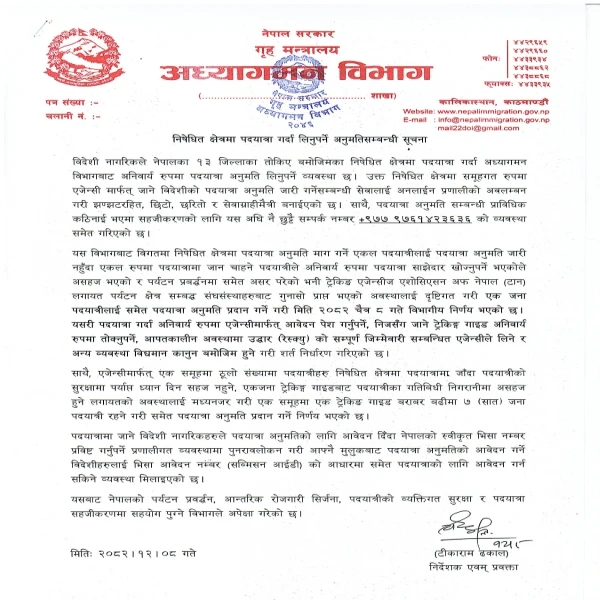
The Department of Immigration, Government of Nepal, has issued an urgent official notice regarding mandatory enrollment in the Foreign Nationals Management Information System (FNMIS). This new digital system has been introduced to enhance security, strengthen immigration control, control crimes, and ensure systematic management of foreign nationals residing in or visiting Nepal.

What is Foreign Nationals Management Information System (FNMIS)?

Foreign Nationals Management Information System (FNMIS)
The Foreign Management Information System (FNMIS) is a centralized digital immigration database developed by the Government of Nepal. Its purpose is to collect real-time data of foreign nationals from the moment they apply for a visa for Nepal to the moment they leave, store it, and manage detailed information systematically and securely. It is designed to ensure that foreigners are only engaged in activities under their visa category.
This system links with travel and trekking agencies, airlines, hotels, money exchange counters, and all service providers that interact with foreigners. This move indicates Nepal’s move toward digital governance and improved immigration monitoring.
Purpose of FNMIS
There are three main purposes of FNMIS they are:
To reduce the misuse of Visas: In Nepal, many foreigners are found to be engaged in business operations, religious teaching, and many other restricted activities, all though enter Nepal as tourists, travelers, and students.
To store the real-time and reliable data and information, Nepal lacks accurate data on visitors, especially those entering the country via land borders. This gap has made tourism planning, monitoring, and emergency response difficult for the authorities.
For security and law-enforcement concerns: Recent investigations have uncovered cross-border online scams and organized fraud networks operating from within Nepal, raising serious concerns about national security and public safety.
How will this system be implemented?
This system is being implemented in a phased manner.
Phase one: Kathmandu Valley (From January 1 )
Applicable to star-rated hotels within Kathmandu Valley.
These star-rated hotels need to register and regularly update foreign nationals’ details through the FNMIS platform.
Phase two: Nationwide Implementation (From March 1)
Applicable to star-rated hotels outside the Kathmandu valley.
Applicable to travel agencies, airlines, trekking companies, and any service providers dealing with foreign nationals.
How does the FNMIS work?
Foreign national visitors can create or register themselves in the system at the time of applying for a Nepali visa through the mobile app or the official immigration website. They are required to enter the basic personal information, travel plans, and visa details.
After submitting the application form, the system sends a six-digit token to the applicant's registered mobile number, allowing them to access the Login page. The Department of Immigration then reviews the submitted applicant's information and verifies the documents before activating the user account.
Once approved, the system issues a unique QR code that is directly linked to the visitor’s identity and visa status. This QR code serves as the main digital ID for the foreign national during their stay in Nepal.
After arriving in the country, visitors present this QR code at hotels and lodges, where it is scanned to automatically update their stay details in the central database. The same QR-based verification is used for domestic air travel, trekking services, currency exchange, and accommodation in other locations.
In cases where visitors have not completed registration beforehand, accommodation providers are required to enter the guest’s details into the system at the time of check-in.
Conclusion
The implementation of this Foreign Nationals Management Information System (FNMIS) is a significant step towards the digital modernization of Nepal’s immigration system. It ensures the accurate collection of data and real-time monitoring, and it also helps to enhance transparency, security, and efficiency for both the government and service providers.
All concerned stakeholders are strongly advised to follow the urgent notice and complete their enrollment within the given time frame.
Need Help? Call Us+977 9851163811orChat with us on WhatsApp


Need Help? Call Us+977 9851163811